
AI for Industry, 3D CAD and Sovereignty. Zeta Alpha at Hannover Messe 2026

Zeta Alpha was all-in at Hannover Messe 2026, the world's largest industrial trade fair. The most striking change in 2026 is that we see a real shift towards more concrete, ROI-focused implementations of industrial AI in production. This means less hype, fewer shiny statements and cute prototypes, and more hard questions about performance, integration, governance, and day‑to-day operations.
This shift aligns well with how Zeta Alpha approaches AI solutions and technology in general: AI for industry that works with real manufacturing complexity like messy data formats, siloed systems, non‑negotiable security requirements, and doing the hard work to pull projects through to production. One definite highlight of this for Zeta Alpha was our customer Festo talking about the virtual assistant we developed together in their Central Stage keynote.

AI that understands 3D CAD and connects it to manufacturing knowledge
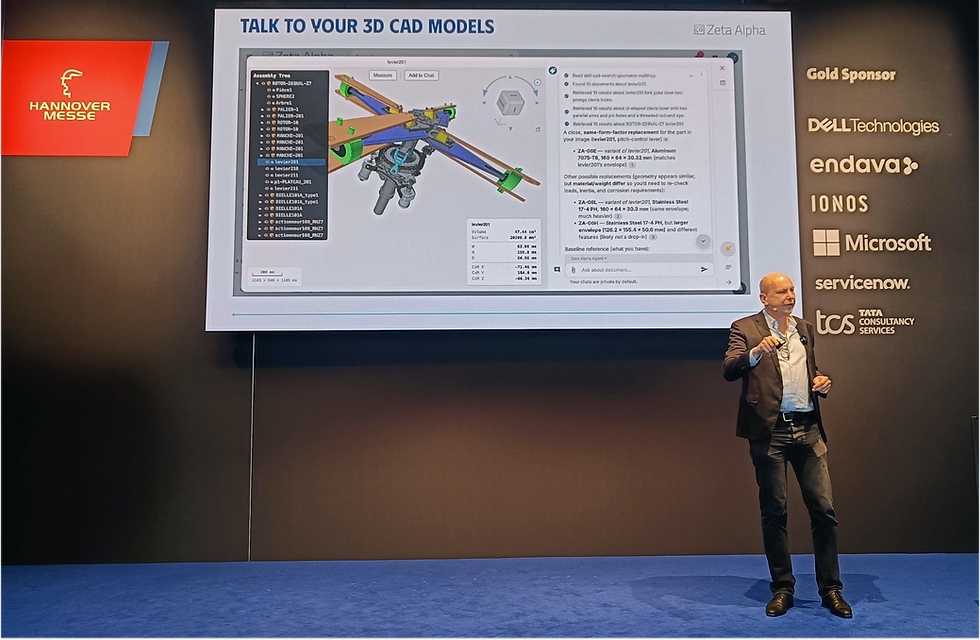
In the same spirit of production-ready AI, we used the Messe to push the boundary of what industrial knowledge AI systems can understand and launched 3D CAD support in Zeta Alpha. In our talk on how AI models can interpret 3D geometry and connect it with enterprise data we discussed unlocking practical use cases like part search, similarity, and design reuse.
sovereign AI for european industry
Manufacturing and engineering data like IP-sensitive designs, supplier details, incident reports, and process know-how can’t be exposed to third parties or leak across teams. This was reflected on the Messe floor, with key speakers like German Chancellor Friedrich Merz and Siemens CEO Roland Busch arguing that sovereign AI is the only way to scale Industrial AI across SMEs that cannot risk their process knowledge in black-box models. At the same time Merz and Busch teamed up to critically reflect on current European AI regulation.
Joined by Andre Wilhelmi (OEDIV), Robert Weber (Industrial AI Podcast, NXAI), and Jens Dorn (OTTO), we hosted a panel on “Sovereign AI for Industry” and how startups and corporates can work on this together. While open-source models are closing the capability gap fast enough to enable serious on‑prem and even air‑gapped deployments, we agreed that “open” doesn’t automatically mean “European”. And for many mid-sized manufacturers sovereignty also means clear accountability, someone local to call for questions and issues, strong governance, and a managed way to run AI safely around IP-rich data.
“Sovereignty is not as an interesting thing by itself or tied to where the model comes from, but really as a question of safety. Are you in control over the operation of your AI application? If you take, let's say, a model from one of the frontier labs which is only served through API, and we've seen this in coding agents, it can just be turned off for you the next day, right? So that's the operational safety level number one.”

Five intense days in the trenches of Industry
At Hannover Messe, our booth conversations showed a clear shift from “AI curiosity” to practical projects people want to start soon. Many visitors shared the same pain points: too much scattered technical information, valuable know-how stuck in experts’ heads, and engineering files that are hard to find and reuse. The strongest interest was in making internal knowledge easy to search, connecting documents with engineering design data, and doing it in a secure way that can also work in restricted environments. Beyond potential customers, we also met many consultants, event organizers, and investors, which opened doors for pilots, partnerships, and introductions into larger industrial companies.
Interested to learn more about our AI for industrial knowledge? Send us a note and we'll be in touch!


Comments