
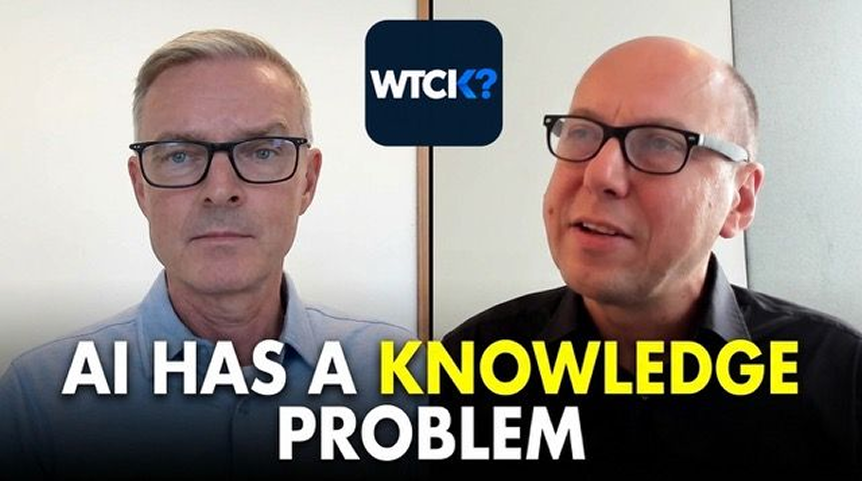
WTCK? Episode 2: What Does It Take to Trust Industrial AI on the Factory Floor?

For industrial AI, there is no such thing as an innocent mistake. A small slip-up from a LLM, like confusing polyamide 6 with polyamide 66, can quickly undermine trust with a researcher or engineer.
On the factory floor, the stakes become even higher: AI has to work with changing physical conditions, information scattered across systems, procedures, sensors, technical documents and tacit knowledge of the expert operators. Most importantly: here, AI directly impacts cost and safety.
In Episode 2 of WTCK? (What the Company Knows): AI Meets the Factory Floor, Stephan Ballenweg and I dig into the realities of operationalizing AI where there is no room for error.
In recent news, we analyze the recent market moves shaping industrial operations:
Siemens and NVIDIA’s industrial AI partnership: Why leading industrial players are betting on digital twins, agentic production planning, and AI’s potential for speeding up engineering cycles.
NEURA Robotics and NXAI: Why robots operating in physical plants need robust long-term memory to adapt to changing environments.
AI on the factory floor: While recent studies report broad corporate AI adoption surges across German industry, deployment directly on the shop floor still lags behind.
Industrial AI on the factory floor: Lessons from BASF
In the second part, Stephan reflects on his journey at BASF and how his background as a PhD chemist shaped the foundational architecture of QKnows AI. We dive into practical industrial deployments, exploring:
Manufacturing knowledge management: the vision (and challenge) of connecting fragmented factory systems (like MES, ERP, PLCs, machine controllers) with maintenance logs, operating procedures, sensor data and operator expertise. This is more than a document-integration problem, it’s about creating a context layer for industrial AI that brings information across these sources together.
The workings of initiatives like BASF’s PlantGPT: Stephan describes PlantGPT as a way to help operators make better-informed decisions, not to operate the plant for them. The early project gave people a chat interface to plant-specific operating knowledge, for example when onboarding or when something unusual happened. The discussion also highlights why experienced operators remain essential: conditions change, and the tacit knowledge of experts needed to interpret them can’t be replaced by a digital twin alone.
The reality check behind deploying humanoid robotics inside existing facilities.
AI as a power tool
One point stands out for me: AI should always be a knowledge-augmentation power tool for experienced people, not a replacement for their expertise and critical judgement, especially when software meets the physical world of factories.
When physical safety and enterprise capital are on the line, the goal is to give skilled operators and engineers the contextual precision they need to make faster, better decisions.
Watch WTCK? Episode 2 on Youtube below or listen in via your podcast app.
Ready to activate what your company knows?
Explore how our industrial knowledge management platform connects scattered operational data, giving expert teams dependable, high-precision intelligence.


Comments